



Recessed lighting looks clean. Modern. It makes any room feel bigger. No wonder Charlotte homeowners want it everywhere.
YouTube makes it look easy. Buy some lights. Cut some holes. Connect some wires. Done in an afternoon.
Recessed lighting may look like a simple cut-and-connect project, but ceilings can hide joists, wiring, plumbing, insulation, and HVAC ducts. A professional maps the space and evaluates the circuit before cutting.
Every year, we get calls from homeowners who started a DIY recessed lighting project and got stuck. Some ran into wiring they didn’t expect. Some cut into ceiling joists. Some tripped breakers they couldn’t reset.
The lucky ones call us before something catches fire.
Let’s talk about what’s actually hiding above your ceiling, and why “just cutting a hole” can turn into a serious problem.
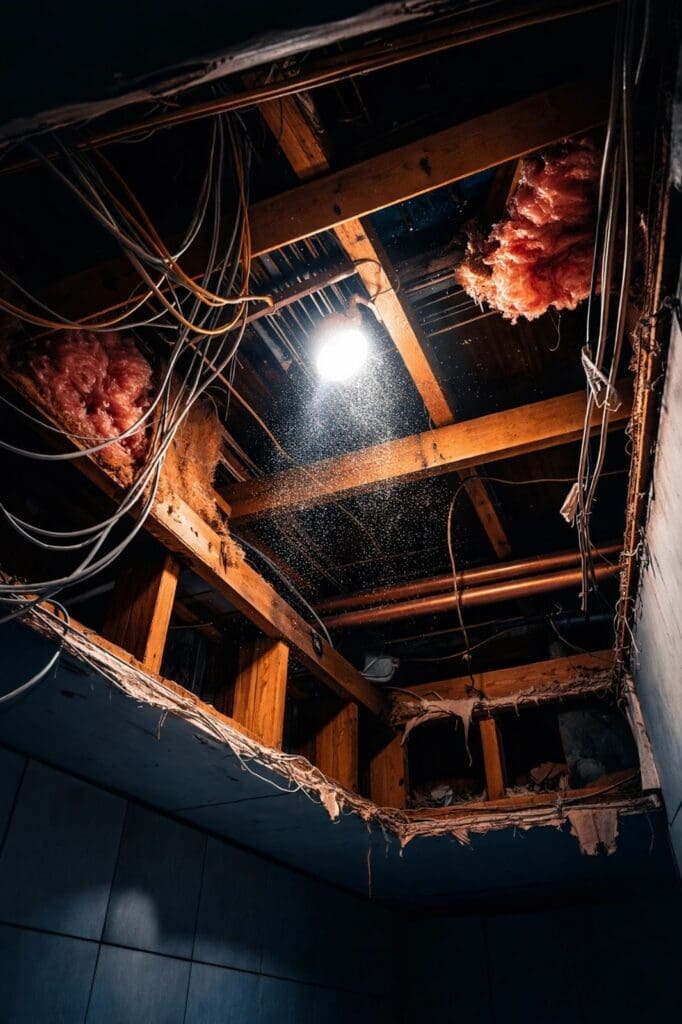
The Hidden World Above Your Ceiling
Your ceiling isn’t just drywall and empty space.
Up there, you have ceiling joists, electrical wiring, possible plumbing, insulation, and HVAC ducts. In a pre-1940 home, the ceiling may also conceal aging knob-and-tube wiring.
You can’t see any of it until you cut.
That’s the first trap. You mark your spots based on a YouTube template. You grab your hole saw. You cut. And suddenly you’re staring at a joist you just damaged. Or a wire you nicked. Or insulation that’s now falling into your living room.
Professional recessed lighting installation in Charlotte NC starts with knowing what’s up there before cutting anything. We use tools and techniques to map out the space. DIYers usually find out the hard way.
Danger #1: Overloaded Circuits
This is the one most people don’t think about.
Your home’s electrical system has limits. Each circuit can only handle so much load. When you add six new recessed lights to an existing circuit, you might push it past capacity.
The result? Breakers that trip constantly. Or worse: breakers that should trip but don’t because they’re old or faulty.
Overloaded circuits generate heat. Heat in your walls and ceiling. Heat you can’t see. This is how electrical fires start.
A residential electrician in Charlotte NC will calculate the load before installing anything. We check:
- What’s already on that circuit
- The wire gauge and breaker rating
- Whether you need a new dedicated circuit
Most DIY tutorials skip this entirely. They assume your existing wiring can handle whatever you throw at it. Bad assumption.
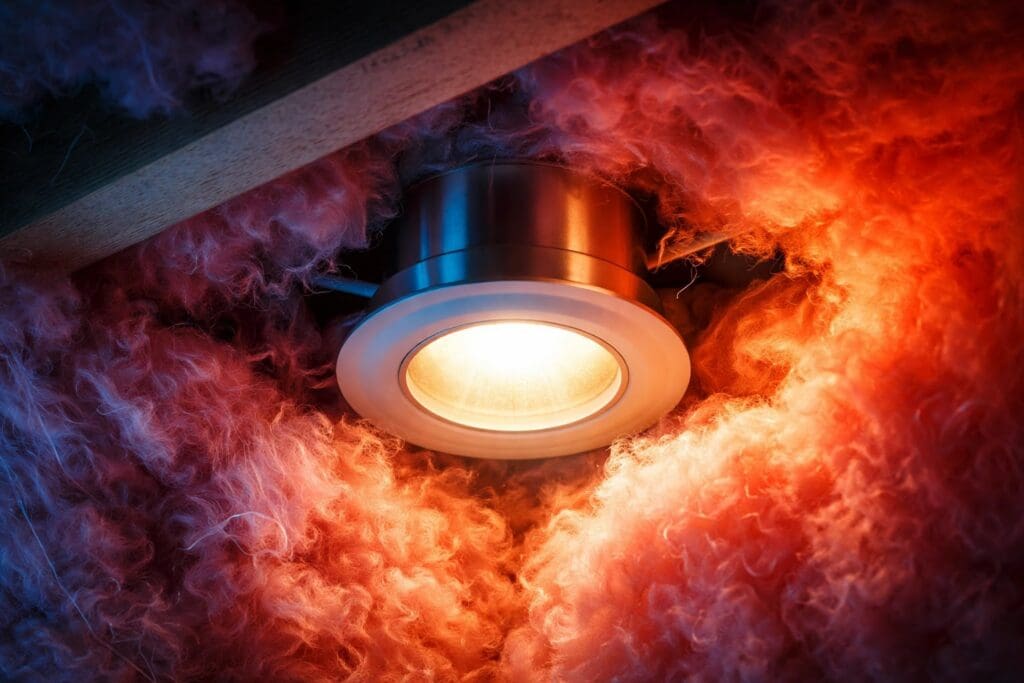
Danger #2: Fire Hazards and Insulation
Here’s something the hardware store doesn’t tell you: recessed lights and insulation don’t always mix.
Traditional recessed cans generate heat. A lot of it. If insulation is packed too close, that heat has nowhere to go. The fixture gets hotter. The insulation gets hotter. Given enough time, you’ve got a fire risk sitting above your head.
There are IC-rated (Insulation Contact) fixtures designed for this. But you need to know:
- Whether your existing fixtures are IC-rated
- Whether your insulation type is compatible
- How much clearance you actually have
Patterson uses the 2020 National Electrical Code (NEC) cycle as the active regulatory framework, together with adopted state and local requirements. A licensed electrician works from that framework and the local inspection requirements. A weekend DIYer usually does not.
Danger #3: Structural Damage
Ceiling joists hold up your roof. They’re kind of important.
When you cut a hole in the wrong spot, you can compromise structural integrity. Even a small notch in a joist weakens it. Do that across multiple joists for a row of recessed lights, and you’ve created a real problem.
You need at least 8 inches of vertical clearance above the ceiling for most recessed fixtures. Not every ceiling has that. Older Charlotte homes especially can have tight spaces, unexpected framing, or multiple layers of ceiling material from past renovations.
Before cutting, you need to:
- Locate every joist
- Verify clearance depth
- Plan hole placement to avoid structural members
Measure twice, cut once isn’t just a saying. It’s the difference between a successful install and a call to a structural engineer.
The “Canless” Light Misconception
You’ve probably seen canless LED recessed lights at the hardware store. They’re thinner. Easier to install. No bulky can required.
Some homeowners think this means they can skip the electrical planning. Just cut a small hole, connect to existing wiring, done.
Not quite.
Canless lights still draw power. They still add load to your circuits. They still need proper connections that meet code. The junction box requirements are different, but they exist.
And here’s the thing: because canless lights are easier to install, people tend to install more of them. A dozen canless LEDs on an old 15-amp circuit is still a recipe for problems.
The fixture being smaller doesn’t make the electrical planning optional.
The Permit and Insurance Problem
This is the trap nobody talks about until it’s too late.
Most jurisdictions require permits for electrical work. Charlotte included. Installing recessed lighting without a permit is technically illegal.
More importantly, if you do unpermitted electrical work and something goes wrong, your homeowner’s insurance may deny your claim.
House fire from faulty wiring? If the insurance adjuster finds unpermitted electrical work, you could be on the hook for everything. We’ve seen it happen.
A licensed residential electrician pulls the proper permits. The work gets inspected. Everything is documented and up to code. Your insurance stays valid.
That peace of mind is worth more than the money you’d save doing it yourself.
What a Professional Installation Actually Looks Like
When Patterson Contracting Services handles recessed lighting installation in Charlotte NC, here’s what happens:
Assessment. We look at your existing electrical system. Panel capacity. Circuit loads. Wire conditions. We figure out what your home can handle before we touch anything.
Planning. We map the ceiling. Locate joists, wiring, and obstacles. Plan fixture placement for even light distribution: typically 4 to 6 feet apart depending on the room.
Permits. We pull the required permits. Your work is legal and documented.
Installation. Holes are cut precisely. Wiring is done to code. Fixtures are properly rated for your insulation situation.
Inspection. The work gets inspected by the city. You get documentation that everything is up to standard.
That’s the difference between a DIY project and professional work. It’s not just about the end result looking good. It’s about knowing the job was done safely and legally.
When DIY Makes Sense (And When It Doesn’t)
Look, we’re not here to say you can’t do anything yourself. Changing a light switch? Swapping a fixture for one with the same wiring? Probably fine for a handy homeowner.
But recessed lighting hits different. You’re cutting into structure. You’re adding load to circuits. You’re dealing with insulation and clearance issues. You’re working in spaces you can’t fully see.
The risk-reward math doesn’t add up for most people.
If you’re planning a recessed lighting project in your Charlotte home, get a professional assessment first. It might turn out your ceilings are perfect for DIY. Or it might turn out there’s knob-and-tube wiring up there that needs attention before you add a single light.
Either way, you’ll know what you’re dealing with.
Get It Done Right
Patterson Contracting Services handles recessed lighting installation throughout the Charlotte area. We also offer electrical safety checks for homeowners who’ve already started a project and want a professional set of eyes on it.
No judgment. Just solutions.
Your ceiling will thank you.
Frequently Asked Questions
What can be hidden above a ceiling?
Ceiling joists, electrical wires, plumbing, insulation, HVAC ducts, and sometimes older wiring can be hidden above a ceiling. That is why the space needs to be mapped before cutting.
Can new recessed lights overload an existing circuit?
Yes. Adding lights can push an existing circuit past its capacity if the current load, wire gauge, and breaker rating are not checked first.
Do canless lights avoid electrical requirements?
No. Canless lights still draw power, add load to circuits, and require proper connections that meet code.