



You’ve probably got an HVAC maintenance agreement. You change your filters, schedule tune-ups twice a year, and keep that system running smoothly. Smart move.
But here’s a question: What about your electrical system?
Without power, your HVAC doesn’t matter. Your fridge doesn’t matter. Nothing in your house works. Yet most Charlotte homeowners never think about preventive electrical maintenance until something goes wrong.
That’s where an electrical energy audit comes in. And here’s the surprising part: it doesn’t just prevent problems. It can actually put real money back in your pocket every single month.
One of our clients said it best: “This is great, we found them date night and family vacation money.”
Let me show you how.
What Is an Electrical Energy Audit?
An electrical energy audit is a comprehensive inspection of your home’s electrical system, but it goes way beyond just making sure things are safe and up to code.
A licensed electrician examines:
- Your electrical panel and circuit capacity
- Major appliances and their energy draw
- Lighting systems throughout the home
- Outlets, switches, and wiring
- HVAC electrical connections
- Any inefficiencies or energy waste points
But the real value comes from two specific technologies: thermal imaging and detailed utility analysis.
These aren’t things you can DIY with a YouTube video. They require professional equipment, training, and the experience to know what you’re actually looking at.
Thermal Imaging: Seeing the Invisible
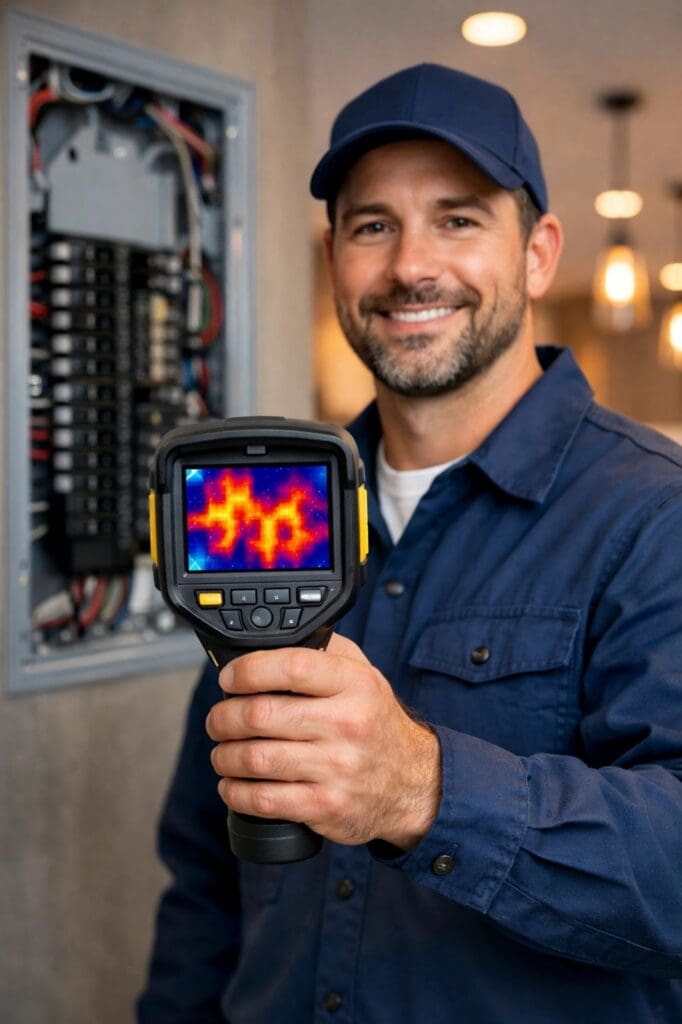
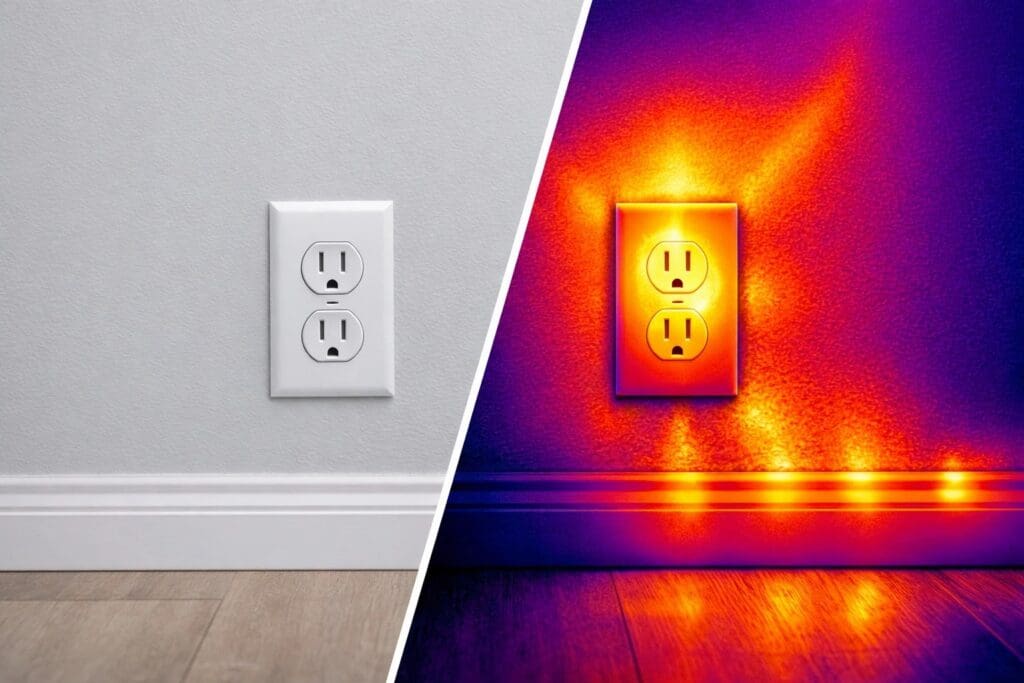
Thermal imaging cameras detect heat signatures that are completely invisible to the naked eye. When we perform an electrical energy audit in Charlotte, we use these cameras to identify problems you didn’t even know existed.
What does thermal imaging reveal?
Hot spots in your electrical panel. If a breaker or connection is running hot, that’s energy waste at best and a fire hazard at worst. These issues show up bright on a thermal scan but would go completely unnoticed otherwise.
Loose connections. A loose wire creates resistance. Resistance creates heat. Heat creates wasted energy and potential danger. Thermal scans catch these issues before they become serious problems.
Insulation gaps. While we’re scanning electrical components, we often spot insulation problems that are costing you money on heating and cooling. Air leaks around outlets and switches show up clearly on thermal imaging.
Overloaded circuits. Circuits that are handling more load than they should run hotter than normal. We can see this immediately with thermal scanning and recommend solutions before you’re dealing with tripped breakers or worse.
Faulty appliances. That refrigerator that seems to run constantly? Thermal imaging can show us if it’s working harder than it should, drawing more power, and driving up your electric bill.
This isn’t guesswork. It’s hard data captured by professional-grade equipment and interpreted by licensed electricians who’ve seen thousands of homes across Charlotte.
Breaking Down Your Electric Bill
Here’s where things get interesting. Most people look at their electric bill, see the total, and either pay it or complain about it. That’s it.
During an electrical energy audit, we do something different. We analyze your actual usage patterns and identify exactly where your money is going.
Baseline consumption. We establish what your home should reasonably use based on square footage, number of occupants, and typical Charlotte weather patterns. If you’re significantly over that baseline, something’s wrong.
Peak usage times. By examining your bill’s time-of-use data, we can identify when you’re consuming the most power and why. Maybe your water heater is oversized. Maybe your HVAC is running inefficiently during the day. Maybe you’ve got “phantom loads” from devices that draw power 24/7 even when they’re off.
Seasonal variations. Charlotte’s summers are brutal, and winters can be surprisingly cold. We look at how your consumption changes across seasons and determine if those swings are normal or if there’s an efficiency problem.
Comparison data. We compare your consumption to similar homes in the Charlotte area. If you’re using 30% more power than a comparable house, that’s a red flag worth investigating.
The goal isn’t just to tell you you’re using too much electricity. The goal is to identify specific, fixable problems that are costing you real money every month.
Real Savings: The “Vacation Money” Story
I mentioned that client quote earlier. Let me give you the full story.
We performed an electrical energy audit for a family in South Charlotte. Nice house, about 2,400 square feet, built in 2008. They called us because their electric bills seemed high, but they didn’t know why.
Our audit found several issues:
Their electrical panel had multiple loose connections causing heat buildup. Not dangerous yet, but inefficient and wasting energy. Their pool pump was running 24/7 on an old timer that had failed in the “on” position. Nobody noticed because the pump was behind the house and they weren’t using the pool in winter.
They had 47 old incandescent recessed lights throughout the house. Every single one was generating heat and drawing way more power than modern LED equivalents. Their water heater was set to 140 degrees, far hotter than necessary, and was located in an unconditioned garage, losing heat constantly.
We created a phased upgrade plan. Some fixes were immediate and inexpensive. Others we scheduled over the next year based on their budget.
The result? Their average monthly electric bill dropped from around $285 to $165.
That’s $120 per month. That’s $1,440 per year.
That’s when they said it: “This is great, we found them date night and family vacation money.”
And they were right. An electrical energy audit didn’t just save them money. It literally funded new experiences for their family.
Developing a Long-Term Upgrade Plan
Here’s what separates a professional electrical energy audit from a simple inspection: we don’t just find problems, we create a roadmap for fixing them.
Not everyone has the budget to address every issue immediately. We get that. So we prioritize:
Safety first. If there’s a hazard, we address it now. No exceptions.

High-impact, low-cost fixes. These are the quick wins. Replacing incandescent bulbs with LEDs. Adjusting water heater temperature. Installing smart power strips to eliminate phantom loads. These changes pay for themselves quickly.
Medium-term improvements. Upgrading to a smart thermostat, installing occupancy sensors in less-used rooms, or replacing an oversized, inefficient appliance. These require more investment but deliver significant long-term savings.
Major upgrades. Panel upgrades, whole-home surge protection, or a complete lighting retrofit. These are planned investments that we schedule based on your timeline and budget.
The beauty of this approach is that you’re always moving forward. Every few months, you complete another upgrade. Your efficiency improves. Your bills drop. And each improvement helps fund the next one.
It’s not overwhelming. It’s not all at once. It’s a structured plan that makes sense for your home and your budget.
The HVAC Comparison Nobody Talks About
Let’s go back to that HVAC maintenance agreement.
You pay for it every year. You schedule the tune-ups. You replace filters. You do this because you understand that preventive maintenance:
- Keeps your system running efficiently
- Prevents expensive breakdowns
- Extends the life of your equipment
- Saves money on energy bills
Every single one of those benefits applies to your electrical system too.
But here’s the critical difference: Without power, your HVAC doesn’t work. Without power, nothing works.
Your electrical system is the foundation of your entire home. It powers your HVAC, your refrigerator, your lights, your internet, your security system, everything. Yet most Charlotte homeowners never think about maintaining it until something breaks.
That doesn’t make sense.
An electrical energy audit is preventive maintenance for the most critical system in your home. It identifies problems before they become emergencies. It improves efficiency so you’re not wasting money every month. It extends the life of your electrical components. And it gives you peace of mind that everything is working safely and correctly.
You wouldn’t skip your HVAC tune-up. Why skip your electrical inspection?
What Happens During the Audit
When you schedule an electrical energy audit with Patterson Contracting Services, here’s what you can expect:
Comprehensive visual inspection. We examine your entire electrical system, from the service entrance to every outlet and switch.
Thermal imaging scan. We use professional-grade thermal cameras to identify hot spots, loose connections, and efficiency problems invisible to the naked eye.
Panel assessment. We check your electrical panel for capacity, proper labeling, signs of wear, and safe operation.
Load analysis. We measure the actual electrical load your home is drawing and compare it to your panel capacity and usage patterns.
Utility bill review. We analyze your electric bills to identify usage patterns and compare them to expected consumption for a home like yours.
Appliance and lighting assessment. We evaluate major appliances and lighting systems for efficiency and identify upgrade opportunities.
Written report. You get a detailed report of our findings, including thermal images, identified issues, and recommended solutions.
Customized upgrade plan. We create a prioritized, phased plan for addressing any issues we found, scheduled around your timeline and budget.
The whole process typically takes 2-3 hours depending on your home’s size. And it’s an investment that pays for itself through the savings it uncovers.
Why a Licensed Professional Matters
You might be wondering: “Can’t I just buy a thermal camera online and do this myself?”
Technically, yes. You can buy a consumer-grade thermal camera for a few hundred dollars.
But here’s what you can’t buy online: the training and experience to know what you’re looking at.
A hot spot on a thermal scan could mean a dozen different things. Is it a loose connection? An overloaded circuit? A failing breaker? A problem with the wiring itself? Each requires a different solution.
A licensed electrician in Charlotte NC has spent years learning to diagnose electrical problems. We know what normal looks like. We know what dangerous looks like. We know what inefficient looks like. And we know how to fix it safely and correctly.
Plus, any repairs or upgrades that come from the audit need to be done by a licensed professional anyway. Electrical work requires permits and inspections. It needs to meet Charlotte’s electrical codes. It needs to be done safely.
Starting with a professional electrical inspection in Charlotte NC means you’re getting accurate information and access to the expertise needed to act on it.
Ready to Find Your Vacation Money?
Most Charlotte homeowners have no idea how much money they’re leaving on the table every month. Inefficient systems, outdated lighting, phantom loads, and hidden electrical problems are quietly draining their bank accounts.
An electrical energy audit finds that money and puts it back where it belongs: in your pocket.
Whether you’re planning date nights, saving for a family vacation, or just tired of watching your electric bill climb every month, an audit gives you a clear path to real, measurable savings.
At Patterson Contracting Services, we’ve helped hundreds of Charlotte families reduce their energy costs through professional electrical audits. We’ll show you exactly where your money is going and create a realistic plan to keep more of it.
Ready to see what we can find? Contact us to schedule your electrical energy audit. Let’s start putting that vacation money back where it belongs.